

- Home
- Investors Centre
- Sustainability
- Talent
- News
- Insights
- TH!NK
- Corporate Governance
- Who we are
- Board of Directors
- Community
- MCB Offices
Contact Info
Oil Shockwaves: How the US-Israel-Iran war would ripple through markets and economies
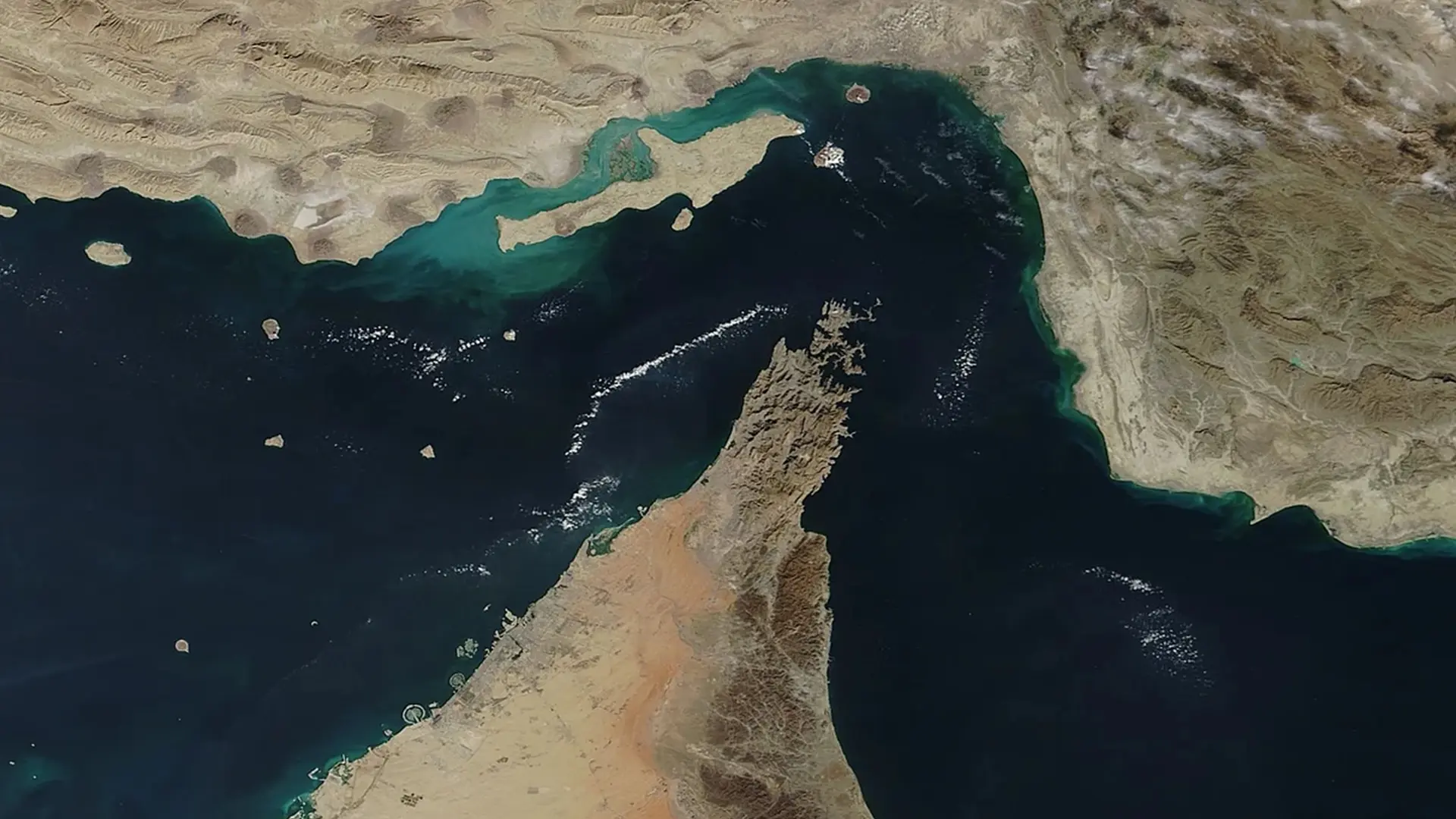
The ongoing war between the United States, Israel, and Iran has injected a substantial geopolitical risk premium into global energy markets, materially altering oil price dynamics. The Strait of Hormuz, which facilitates roughly one-fifth of global crude flows, represents a critical chokepoint in the global energy system. Its effective disruption as well as damage to critical energy infrastructure have transformed what was once a regional flashpoint into a structural supply shock with far-reaching implications for global trade and inflation.
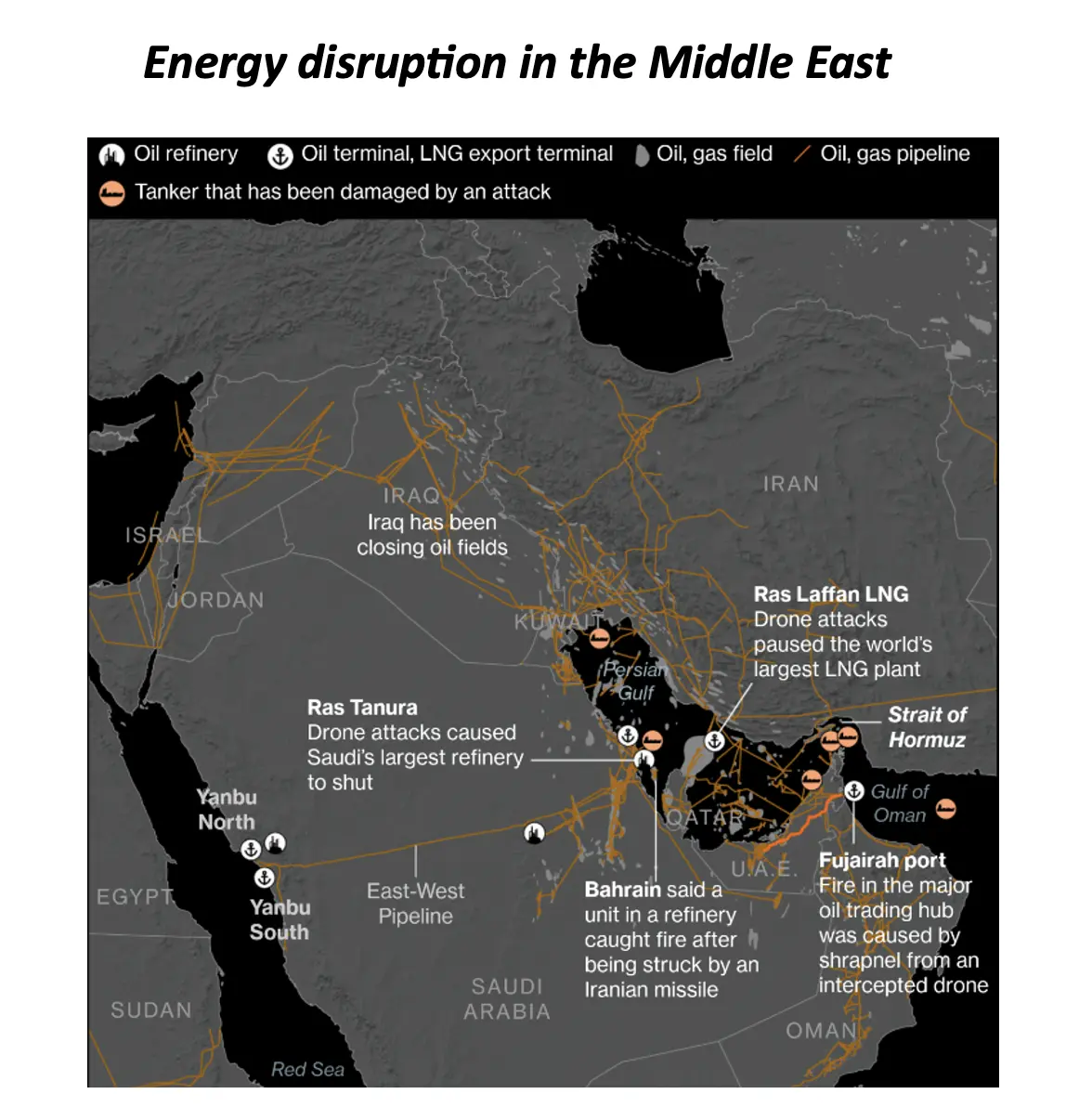
Source: Bloomberg
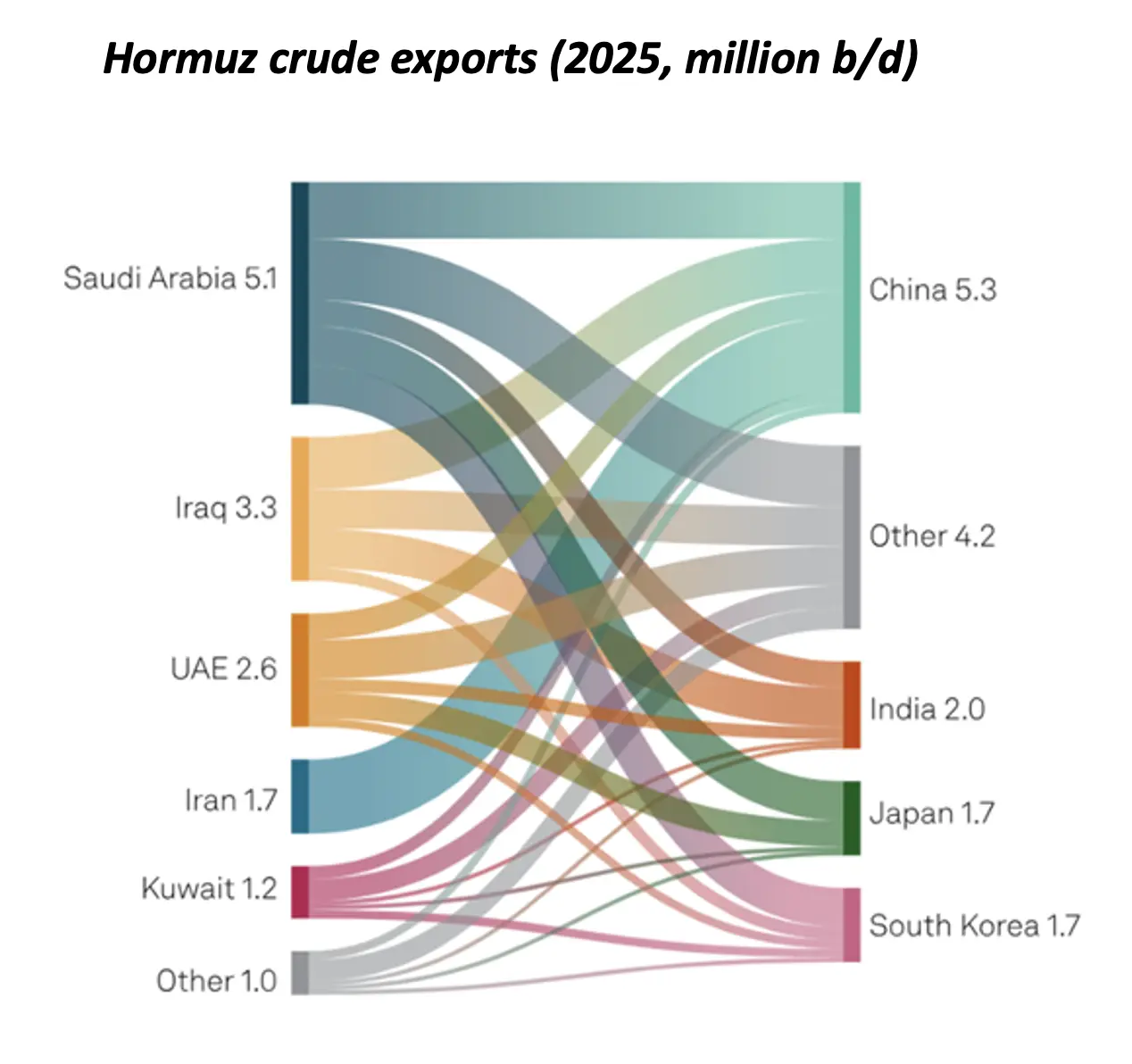
Source: S&P
Oil market conditions
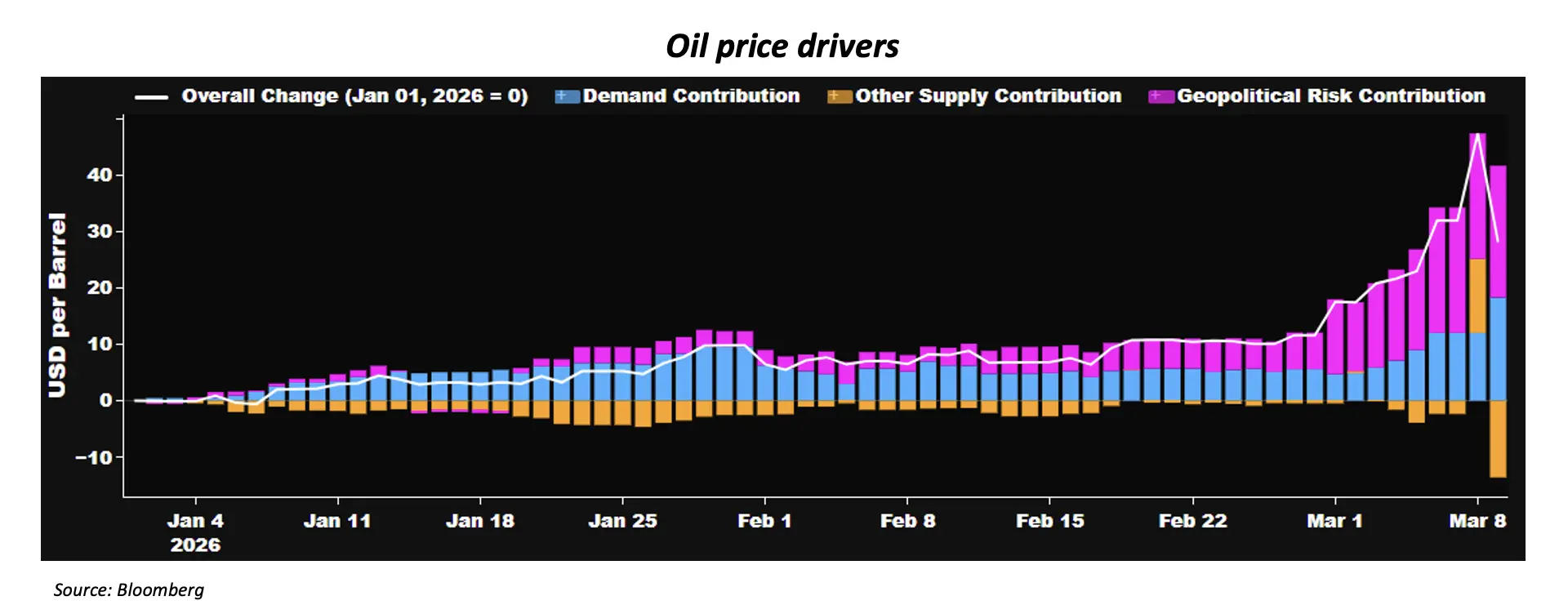
Oil prices, which was already embedding an estimated USD 6–10/bbl geopolitical premium prior to the war, have reacted sharply: Brent crude jumped to almost USD 119/bbl on 9 March, its highest since mid-2022 but went down quickly towards USD 95/bbl level following comments by President Trump that the end of the war is imminent. Nonetheless, that level is still 28% higher relative to the pre-war period.
On the supply side, OPEC+ announced a 206,000 b/d production increase starting April 2026, larger than expected, but still amounting to less than 0.2% of global supply. In the current environment, it is not that material relative to the scale of flows at risk through Hormuz. Crucially, most OPEC spare capacity sits inside the Persian Gulf. If the chokepoint is disrupted, additional barrels cannot easily reach market. Indeed, JP Morgan estimates that a 25-day halt in Hormuz would fill producer storage tanks and force output shut-ins. Even with pipeline diversions, notably Saudi Arabia’s ability to reroute some flows westward to the Red Sea, supply at risk would still sit at 15-20% of global supply, and that corridor itself faces potential vulnerability if regional proxies expand attacks. Iraq has already cut roughly 3 million b/d (mb/d), Kuwait (OPEC’s fifth largest producer) by up to 0.3 mb/d and the UAE has also begun to reduce production, bringing total reported cuts to at least 3.5 mb/d as per JP Morgan. Compounding the supply risk, freight charges and maritime insurance markets are tightening sharply: war-risk cargo insurance has jumped from roughly 0.03% of cargo value to about 1% in affected zones, while MSC introduced a war surcharge on shipments to Africa and Indian Ocean (USD 2,000 for 20-foot containers, USD 3,000 for 40-foot containers and USD 4,000 for refrigerated), further discouraging shipments and amplifying the effective supply shock.
As regards demand and inventories, countries are already adjusting. India and Indonesia seeking alternative supplies, while in China (which receives around half of its oil imports from the Gulf), the government has told the nation’s largest oil refiners to suspend exports of diesel and gasoline. For its part, Japanese refiners are asking their government to release oil from strategic petroleum reserves. In the US, crude inventories unexpectedly rose by 5.6 million barrels the previous week, well above expectations of 2.3 million, but the authorities have not yet signalled an immediate release from the Strategic Petroleum Reserve (SPR), which at around 415 million barrels is already about 35% below its early 2021 level after heavy use during the Russia–Ukraine war. For now, consuming markets have not fully felt the shortage because cargoes loaded before the escalation are still arriving (roughly 10 days to India, 21 days to China, and about 10 days to Northwest Europe), temporarily masking disruptions as this logistical buffer gradually shrinks
In the wake of the war, the Brent futures curve has shifted upwards while remaining in backwardation, albeit with a steeper gradient. In effect, the curve is signalling that for now, markets see the shock as front-loaded and acute. Of note, pre-war, the May-26 contract was trading around USD 72.87/bbl but it has since surged to roughly USD 92.38/bbl, reflecting an aggressive injection of geopolitical risk premium and a tightening of prompt supply expectations. By contrast, the December contract has risen more modestly, from USD 68.64/bbl to USD 73.24/bbl, suggesting that while traders are pricing immediate scarcity and elevated disruption risk, they continue to assume some degree of normalisation over the medium term. The steeper backwardation hence implies intensified near-term physical tightness but not yet a structural repricing of the longer-dated supply-demand balance
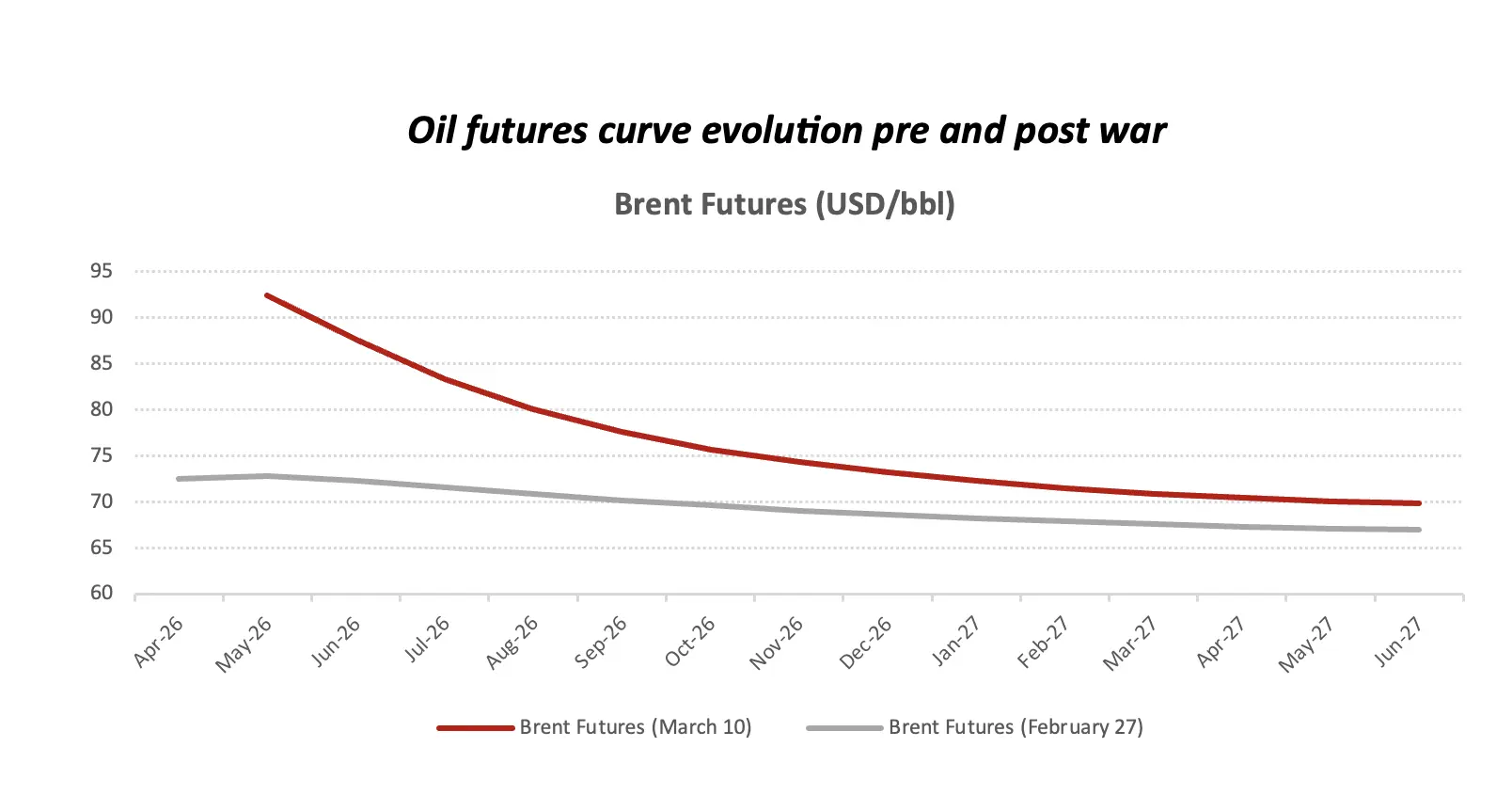
Source: Bloomberg
A historical analysis of how oil performs during wars
It is instructive to examine how oil markets have historically responded to geopolitical shocks. While prices often spike sharply in the immediate aftermath of conflict, these surges have typically proven transient as supply chains adjust, strategic reserves are deployed, and risk premia gradually unwind
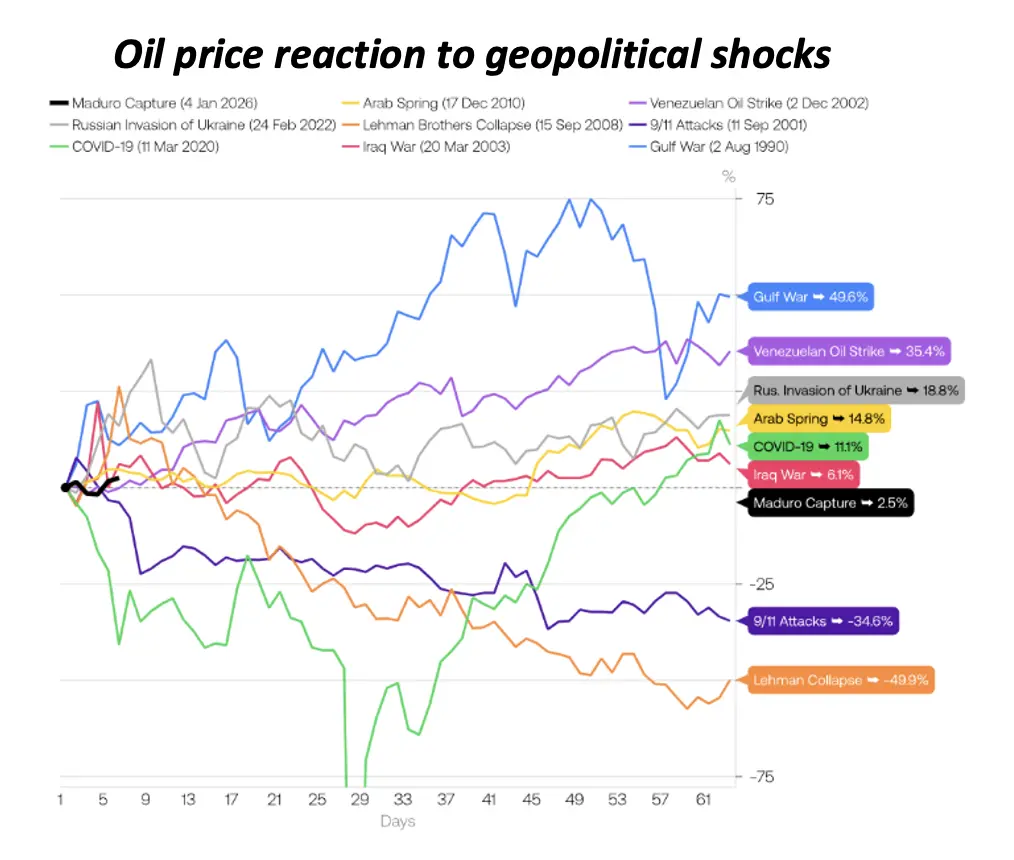
Source: Macrobond
- In 1990, following Iraq’s invasion of Kuwait, oil prices surged by approximately 89%, only to reverse course and fall by 57% within nine months.
- During the 2003 US–Iraq war, crude rose around 24% before declining 33% over the subsequent twelve weeks.
- In 2022, the outbreak of the Russia–Ukraine war sent oil prices surging to around USD 130/bbl as markets grappled with the potential disruption of 7–8 mb/d of Russian supply, equivalent to roughly 7–8% of global output. As fears of sustained supply losses eased, prices retraced by roughly 43% over the following 18 weeks.
- More recently, during the brief 12-day Israel–Iran confrontation in June 2025 (which started on June 13), oil prices incorporated an estimated USD 10–15 per barrel risk premium, which dissipated quickly once it became clear that energy flows through the Strait of Hormuz would resume and that regional infrastructure had not sustained lasting damage.
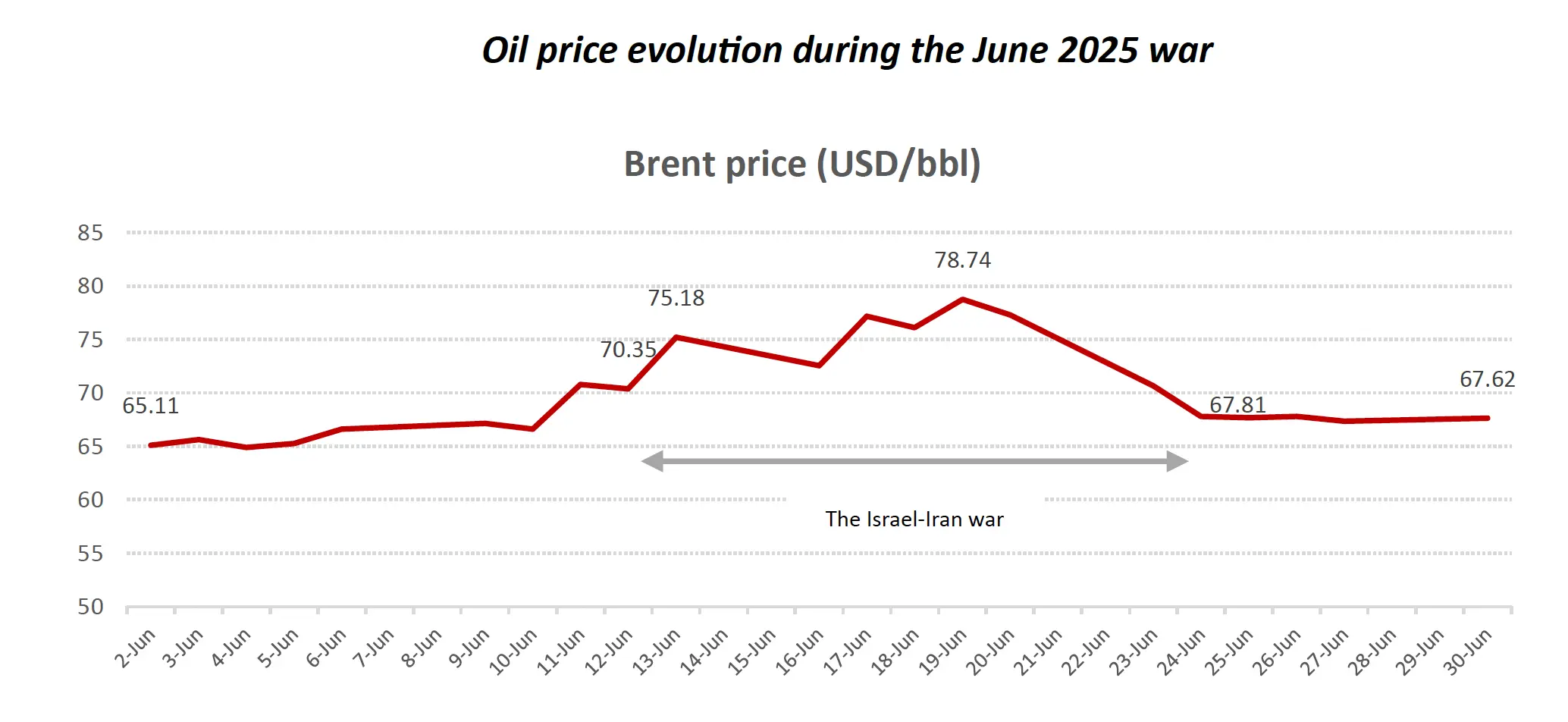
Source: Bloomberg
Overall, across ten major conflicts over the past 35 years, the average decline after the initial price spike has been in the order of 35%. The historical pattern is clear: while conflict injects an immediate and often severe risk premium into oil markets, that premium has often faded as physical supply disruptions proved less persistent than initially feared.
Outlook
Our baseline scenario assumes Brent crude will hover in the USD 85–95/bbl range in the near term, as markets continue to price in geopolitical risk linked to disruptions to Gulf energy infrastructure and shipping routes, including the Strait of Hormuz. As tensions gradually ease and the conflict de-escalates during this month, the geopolitical risk premium should fade, allowing prices to retreat toward USD 65–70/bbl, broadly returning to pre-conflict levels as supply flows normalize and underlying market fundamentals reassert downward pressure.
In the interim, however, volatility is likely to remain elevated. Markets remain highly sensitive to developments in the region, particularly the possibility of Iranian retaliation targeting energy logistics or maritime traffic. Even limited disruptions could sustain a temporary risk premium in oil prices. On the other hand, policy responses may play a stabilising role. The US is reportedly considering a range of measures to curb rising energy prices, including releases from the Strategic Petroleum Reserve (SPR), coordination with other members of the International Energy Agency (IEA), and the potential easing of oil sanctions on some countries like Russia to ensure barrels continue to reach global markets. Discussions among G7 finance ministers on March 9 regarding a coordinated release of stocks, have already helped temper the initial panic premium embedded in prices, albeit they did not proceed with the latter. Of note, the IEA group's members hold more than 1.2 billion barrels of public emergency oil stocks, and the US is reportedly advocating a 300–400 million barrels drawdown, equivalent to 25–30% of total IEA stocks.
The main upside risk to the oil market centers on Kharg Island, Iran’s critical export hub that handles roughly 90% of the country’s crude exports and underpins its oil infrastructure. If Kharg were disabled, the loss of its storage capacity and lack of alternative export routes could rapidly trigger upstream shut-ins, placing a significant share of Iranian production at risk. With output currently near 3.3 mb/d and exports around 1.5 mb/d, a direct outage at Kharg alone could remove an additional 1–1.5 mb/d from the market, pushing broader regional disruptions above 4 mb/d by the end of next week. In such a severe disruption scenario, Brent crude could surge above USD 120/bbl, particularly if shipping through the Strait of Hormuz remains halted and the conflict escalates further, potentially involving the death of Iran’s new leader and broader regional spillovers. While strategic reserve releases could cushion the initial shock, such measures would offer only temporary relief. Moreover, any supply response from alternative producers, including the US shale industry, would likely prove insufficient in the near term, as bringing meaningful additional output to market typically requires six to twelve months.
As regards the macroeconomic implications, the ongoing oil shock raises the risk of a stagflationary environment for major advanced economies. Oil prices sustained within the USD 85–95/bbl would compress global real incomes and consumer purchasing power, by adding 0.5–0.7 percentage points to headline inflation in advanced economies, potentially prompting central banks to delay cuts and keep monetary policy tight. However, should the war persist, the macroeconomic consequences would intensify sharply. An oil spike toward USD 125/bbl could lift US inflation by almost 1.5 percentage points while shaving around 0.7 percentage points from economic growth. The eurozone would face even stronger stagflationary pressures, with inflation rising by nearly 2 percentage points and GDP growth falling by close to 1 percentage point.
Financial markets implications
Against this volatile backdrop, financial markets have been repricing risks, while central bank expectations are shifting sharply.
- Markets no longer fully price a FED cut until September, pushed back from July expectations. Markets are now pricing in 43 basis points of rate cuts by year-end, down from 61 basis points before the war.
- In Europe, the repricing has been even more dramatic. On February 27, markets assigned roughly a 50% probability of a European Central Bank rate cut in 2026. That probability has now collapsed to zero and markets now see atleast one or two hikes for this year depending on the energy price evolution.
- Meanwhile, for the Bank of England, traders now see only a 15% chance of a cut this month, down from 75% before the war and markets also see a chance of a hike by year-end.
The US dollar has exhibited clear haven characteristics, with the DXY rising around 1% since pre-war. Despite recurring debates over its safe-haven status, the greenback continues to benefit from its reserve currency role, particularly given the nature of the shock. Meanwhile, fixed-income markets initially exhibited a more complex response, oscillating between safe-haven demand and inflation repricing. Elevated geopolitical tensions compressed yields via flight-to-quality flows but shortly afterwards, higher inflation expectations exerted upward pressure on yields, with the US 10-year yield currently at 4.09%, up roughly 15 basis points since pre-war.
Looking ahead, we believe that as a net energy exporter, the United States may see a relative terms-of-trade improvement, reinforcing dollar strength during oil-driven geopolitical crises. Should the conflict persist and energy prices climb further, the dollar is likely to remain supported both by defensive capital flows and by shifting monetary policy expectations. Treasury yields would also rally, potentially towards the 4.3% area, given rising inflation expectations in the face of higher energy prices. Of note, historically, oil prices and the US 10-year Treasury yield tend to move broadly in the same direction: positive oil price shocks and upside data surprises lift yields, while heightened policy uncertainty compresses them. That said, if safe-haven demand dominates, yields could temporarily dip and hover around 4% levels seen just days ago. This tug-of-war between flight-to-safety flows and inflation repricing is likely to keep US Treasury markets volatile in the coming weeks.


Recent Articles





TH!NK





Subscribe to our Email Alerts
Stay up-to-date with our latest releases delivered straight to your inbox.
Contact
Don't hesitate to contact us for additional info
Email alerts
Keep abreast of our financial updates.