

- Home
- Investors Centre
- Sustainability
- Talent
- News
- Insights
- TH!NK
- Corporate Governance
- Who we are
- Board of Directors
- Community
- MCB Offices
Contact Info
Uganda’s potential begins to take shape
.webp?sfvrsn=bdba599c_1)
For much of the past decade, Uganda’s economic narrative has centred on potential. Today, that story is gradually shifting towards delivery. With the East African Crude Oil Pipeline (EACOP), which will connect Uganda’s Lake Albert oilfields to Tanzania’s port of Tanga, progressing towards completion and first oil production drawing closer, the country appears to be entering a new phase of its economic development. While challenges remain, particularly on the fiscal front, the broader macroeconomic backdrop is becoming increasingly supportive for investors seeking exposure to East Africa’s growth story. In our view, robust growth, contained inflation and a strengthening external position provide a constructive backdrop for Uganda’s longer-dated local-currency government bonds, while also underpinning a more favourable medium-term outlook for the Ugandan shilling.
Oil investment lays foundation for future growth
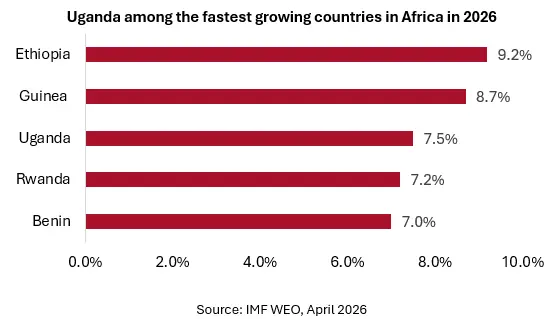
Large-scale investment associated with the EACOP, together with related energy and infrastructure projects, continues to support economic activity across construction, manufacturing and logistics, positioning Uganda among the fastest-growing economies in Sub-Saharan Africa, with growth projected at 7.5% this year. While the authorities continue to target first oil by late 2026, our base case remains that production will commence around the turn of the year, reflecting the complexity of bringing projects of this scale through their final stages of commissioning and operational readiness. Nevertheless, the economic benefits are already evident through elevated investment levels and stronger activity in sectors linked to the oil value chain.
Encouragingly, growth prospects have remained resilient despite the recent Ebola outbreak. While the outbreak has introduced near-term downside risks, notably for tourism and cross-border trade, the absence of widespread community transmission at the time of writing and the expectation that border restrictions will prove temporary suggest that the medium-term growth outlook remains broadly intact.
Equally important is the inflation outlook. Despite elevated global energy prices and rising imports of capital goods linked to oil-sector development, inflationary pressures have remained relatively contained. The limited weighting of fuel in the consumer basket limits the pass-through from higher energy prices, while food prices, which carry a much larger weighting, have been on a disinflationary trend since late 2025, helping offset the energy-related pressures. Consequently, we expect inflation to remain comfortably below the Bank of Uganda's 5% target.
This should allow the Bank of Uganda to maintain its policy rate at 9.75% over the coming quarters, particularly given its recent preference for liquidity management measures, like the increase in the cash reserve ratio, rather than adjustments to the policy rate. Nevertheless, risks remain skewed to the upside, with a further escalation of tensions in the Middle East and an El Niño-induced shock to agricultural production potentially raising inflationary pressures and prompting a more hawkish policy stance.
First oil marks a turning point for external accounts
While the commencement of crude oil exports is unlikely to reduce Uganda's reliance on imported refined fuels in the near term, given the absence of domestic refining capacity and the pending investment decision on the proposed 60,000 bpd Kabaale refinery, it should nevertheless mark a turning point for the country's external accounts.
The immediate benefits of first oil are expected to come through higher export earnings and stronger foreign-exchange inflows rather than lower fuel imports. Uganda's oil story is therefore initially one of export generation rather than energy self-sufficiency. This distinction is important because it supports what is already an improving external position. Strong coffee exports, elevated gold prices and resilient remittance inflows have contributed to a strengthening balance of payments over the past year. Crude oil exports are likely to reinforce this trend and help in improving the current account deficit.
The reserve position is also expected to improve materially. Already, gross foreign-exchange reserves have risen sharply from approximately USD 3.3 billion (bn) in January 2025 to USD 5.6 bn in January 2026, before increasing further to around USD 6.1 bn by May despite heightened global uncertainty. Looking ahead, reserve adequacy is expected to remain comfortably above the IMF's three-month benchmark, supported by stronger export earnings, improving external balances and the Bank of Uganda's domestic gold purchase programme, which provides an additional source of reserve accumulation and diversification.
In light of these improving external fundamentals, the medium-term outlook for the Ugandan shilling is becoming increasingly constructive. The combination of higher export receipts from oil, stronger reserve buffers and continued multilateral financing should strengthen Uganda's balance-of-payments position and improve foreign-exchange liquidity. This should reduce depreciation pressures and provide a firmer anchor for the currency. A successor IMF-supported programme would provide an additional layer of support through stronger policy credibility and investor confidence. While periods of volatility are likely in response to shifts in global risk sentiment and regional security developments, the balance of risks increasingly favours currency stability.
While improving external fundamentals would continue to support the shilling, the durability of this stability would depend, in part, on the government's success in strengthening public finances and advancing fiscal consolidation.
A measured path to fiscal consolidation
Following two years of expansionary fiscal policy, Uganda's fiscal policy appears to be entering a more prudent phase. Nevertheless, rather than relying on expenditure restraint, the government's strategy is centred on strengthening revenue mobilisation while continuing to fund key development priorities. This is reflected in the FY2026/27 budget, which maintains significant allocations for strategic infrastructure projects, including the standard-gauge railway and the proposed oil refinery at Kabaale.
Importantly, the prospect of future oil revenues provides policymakers with greater confidence that fiscal metrics can improve over the medium term without undermining growth-supportive investment. The IMF estimates that oil production could generate average revenues of around 2% of GDP per year over the next decade, providing a new source of government income, although much of these proceeds is expected to be channelled into the sovereign wealth fund.
Fiscal consolidation is likely to proceed at a measured pace. Structural challenges related to expenditure management, budget execution and the sizeable public-sector wage bill continue to limit the scope for rapid adjustment.
Improving fundamentals strengthen the case for duration
From a fixed-income perspective, fiscal developments remain an important determinant of Ugandan local-currency bond yields. In our view, current yields offer meaningful compensation for these risks. Uganda's local-currency bonds continue to provide some of the highest real yields in the region, underpinned by a policy rate of 9.75% and a central bank that has consistently demonstrated a strong commitment to preserving price stability, reinforced by its willingness to tighten liquidity conditions proactively, including the recent increase in the cash reserve ratio to 11%, despite inflation remaining comfortably below target.
With inflation expected to remain anchored around the Bank of Uganda's 5% target, current yield levels appear to reflect fiscal and supply-related premia rather than concerns about a sustained inflationary cycle. As confidence in the macroeconomic outlook strengthens on the back of fiscal execution, there is scope for these premia to compress.
Improving fiscal fundamentals, rising oil revenues and a stronger external position point to lower yields ahead. The case appears particularly compelling at the longer end of the curve. Long-dated bonds continue to offer attractive carry while also benefiting from favourable tax treatment, with a 10% withholding tax rate compared with 20% for securities with maturities below ten years.
The improving macroeconomic environment is also becoming evident in domestic financial markets. While banks and pension funds continue to dominate holdings of government securities, foreign participation has more than doubled from 2025 levels. Although offshore ownership remains low relative to larger frontier markets such as Egypt and Nigeria, the trend points to considerable scope for deeper international participation.
MCB Research
If you have any questions or need assistance, our dedicated support team is here to help: Research desk on research@mcbgroup.com or MCB Global Markets Team on gmsales@mcb.mu
Disclaimer:
“This publication is provided for general information purposes only and should not be construed as investment advice, a recommendation, an offer or solicitation to buy or sell any financial instrument or to participate in any trading strategy. The views and opinions expressed are those of the author(s) as of the date indicated and are subject to change without notice. They do not necessarily represent the views of The Mauritius Commercial Bank Ltd (“MCB”) or any of its affiliates. Although the information contained herein is obtained from sources believed to be reliable, MCB makes no representation or warranty, express or implied, as to its accuracy, completeness, or fitness for any particular purpose. Past performance is not indicative of future results, and all investments involve risk, including the possible loss of principal. Neither MCB nor any of its directors, officers, or employees accepts any liability for any direct or consequential loss arising from any use of this publication or its contents. Recipients should seek independent financial, legal or tax advice before making any investment decisions.”
Recent Articles





TH!NK




Subscribe to our Email Alerts
Stay up-to-date with our latest releases delivered straight to your inbox.
Contact
Don't hesitate to contact us for additional info
Email alerts
Keep abreast of our financial updates.