

- Home
- Investors Centre
- Sustainability
- Talent
- News
- Insights
- TH!NK
- Corporate Governance
- Who we are
- Board of Directors
- Community
- MCB Offices
Contact Info
Oil Prices Return to Pre-War Levels, but Central Banks Are Not Ready to Relax

Brent crude has round-tripped an entire war. Having traded near US$72/bbl on 27 February, the day before the US-Iran conflict began, Brent spiked above US$100 by 8 March and peaked intraday at US$126.41 on 30 April, a four-month surge of more than 55% driven by the effective closure of the Strait of Hormuz. As of this week, it is back at roughly US$72-73/bbl, having fully unwound the geopolitical risk premium. The retracement has been almost as violent as the rally: Brent fell more than 10% in the week to 26 June alone, its largest weekly drop in a month, as Hormuz transits resumed and a 60-day US-Iran truce took hold.
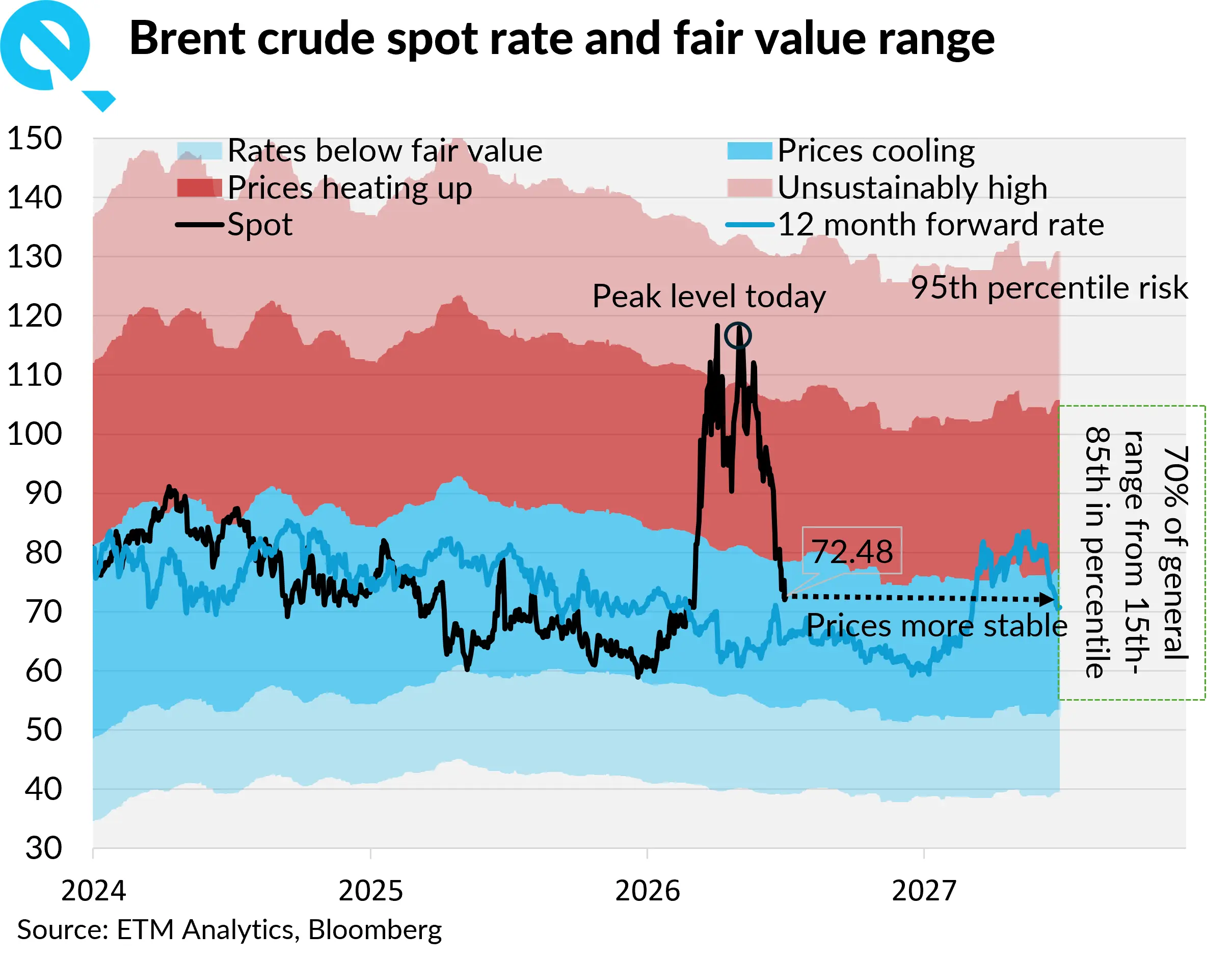
That move has forced a reassessment of the inflation outlook, though not a wholesale unwinding of rate-hike bets. At the wartime peak, markets feared a sustained energy shock would keep headline inflation elevated, and as major central banks indeed delayed the easing cycle, pricing was subsequently repriced sharply toward a “higher-for-longer” stance. The subsequent collapse in crude removes the most visible of those upside risks. Lower oil should feed through to fuel, transport and freight costs and, in time, to headline inflation, which is why the relief has been felt most where energy had recently driven hawkish repricing.
Outside the United States, that is largely how it has played out. In Europe, the UK, and Japan, where the oil spike had pushed markets to price in a greater chance of further hikes, the retreat in crude has allowed investors to walk those bets back. With the immediate energy threat fading, the market is now more comfortable that policy rates in these economies sit on hold rather than moving higher. The key point is that lower oil prices have brought central banks relief, not resolution. It removes an external shock, but second-round inflationary effects could still emerge.
The United States has diverged. Lower oil has removed one source of inflation risk there too, yet markets have not unwound their bets on a hawkish Federal Reserve. Under Chair Kevin Warsh, the Fed has struck a noticeably tougher tone, treating the return of inflation to its 2% target as the overriding priority and shifting the conversation away from energy and towards broader price dynamics. The result is that investors are now watching labour-market and core inflation prints far more closely than the crude price, mindful that the Fed could still tighten if second-round pressures emerge.
Going forward, the Fed's policy outlook is therefore likely to depend less on the direction of crude oil itself and more on whether underlying inflation continues to moderate. If lower energy prices feed through to transport costs and broader inflation without generating persistent second-round effects, the case for additional rate hikes would weaken. However, should core inflation remain sticky or firms continue to pass on earlier cost increases to consumers, the Fed is likely to maintain its restrictive stance and tighten further if necessary to preserve its inflation-fighting credibility. In fact, market pricing has adjusted, with expectations tilting toward additional tightening of 37 bps by year-end. Our view remains for a prolonged pause, though the odds of a hike have increased following the hawkish comments of Warsh.
The forward outlook is far more balanced than at the height of the conflict, when sell-side desks were flagging scenarios toward US$140-150/bbl had the blockade persisted. With Hormuz transits slowly starting to recover and Saudi Arabia loading again at Ras Tanura, consensus now sits close to current levels. Bloomberg's latest survey shows a median Brent forecast of around US$76/bbl over the next month, easing to roughly US$72/bbl by year-end and stabilising near US$70/bbl over the following 12 to 24 months, with comparable paths across WTI and Dubai. That is some US$50 below the late-April peak. However, the risk skew is not symmetric. Several hundred vessels remain stranded in the Gulf, the truce is only 60 days, and renewed tit-for-tat strikes around the strait in late June were enough to lift Brent intraday, a reminder of how thin the peace premium is. OPEC+ supply decisions and the durability of the ceasefire remain the swing factors.
For central banks, the recent decline in oil prices provides welcome relief but not a definitive resolution to the inflation challenge. Policymakers are likely to welcome the moderation in headline inflation that lower energy costs should deliver. However, while crude prices have eased, costs including transport and fertilisers prices remain elevated, which could continue to exert upward pressure on prices. Against this backdrop, central banks will remain focused on whether second-round inflation effects emerge through wages, services and broader price-setting behaviour. Until there is convincing evidence that these underlying pressures, including those linked to still-high input costs, are easing, most major central banks are likely to remain cautious, with markets still pricing in rate hikes even if the immediate threat from higher oil prices has diminished.
For more information, please contact MCB Global Markets Team on gmsales@mcb.mu
Published in collaboration with our Strategy, Research and Development team and our Financial Markets research partner, ETM Group.
Disclaimer
“This publication is provided for general information purposes only and should not be construed as investment advice, a recommendation, an offer or solicitation to buy or sell any financial instrument or to participate in any trading strategy. The views and opinions expressed are those of the author(s) as of the date indicated and are subject to change without notice.
They do not necessarily represent the views of The Mauritius Commercial Bank Ltd (“MCB”) or any of its affiliates. Although the information contained herein is obtained from sources believed to be reliable, MCB makes no representation or warranty, express or implied, as to its accuracy, completeness, or fitness for any particular purpose. Past performance is not indicative of future results, and all investments involve risk, including the possible loss of principal.
Neither MCB nor any of its directors, officers, or employees accepts any liability for any direct or consequential loss arising from any use of this publication or its contents. Recipients should seek independent financial, legal or tax advice before making any investment decisions.”
Recent Articles





TH!NK





Subscribe to our Email Alerts
Stay up-to-date with our latest releases delivered straight to your inbox.
Contact
Don't hesitate to contact us for additional info
Email alerts
Keep abreast of our financial updates.