

- Home
- Investors Centre
- Sustainability
- Talent
- News
- Insights
- TH!NK
- Corporate Governance
- Who we are
- Board of Directors
- Community
- MCB Offices
Contact Info
From debt distress to renewed confidence: Zambia’s next chapter
.webp?sfvrsn=4224eb6d_1)
Can Zambia build on its post-default recovery?
Following its exit from sovereign default in late 2025, Zambia enters a new phase characterised by improving macroeconomic conditions and stronger external buffers. Nevertheless, elevated debt levels, financing constraints and a more uncertain global backdrop suggest that the recovery is likely to remain gradual rather than rapid.
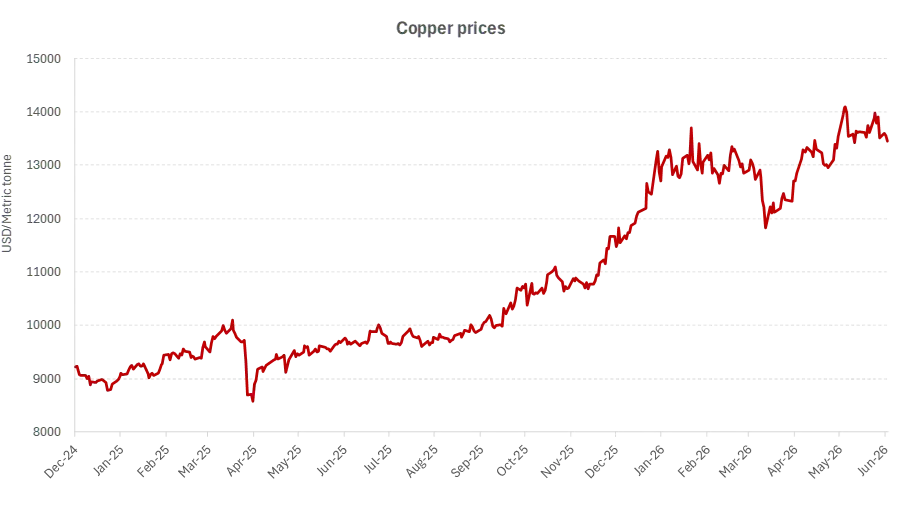
Copper continues to underpin growth prospects
Although growth is expected to accelerate this year, it reflects a downgrade compared to earlier projections amid softer mining activity and persistent electricity shortages. That said, Zambia continues to benefit from favourable copper prices, with the sector accounting for around 70% of export earnings and one-third of government revenues. While authorities maintain ambitious production targets, output gains are expected to materialise only gradually given structural bottlenecks and the long lead times associated with mining investments.
Source: Bloomberg
Zambia stands out as disinflation allows rates to move lower
Unlike many central banks that have become more cautious and scaled back previously anticipated monetary easing amid renewed geopolitical tensions, the Bank of Zambia lowered its policy rate to 13.25% at its May 2026 Monetary Policy Committee (MPC) meeting, as inflation eased to 6.6% in May, well within the central bank’s 6-8% target range, underpinned by favourable food base effects and the appreciation of the kwacha.
Nonetheless, the Middle East conflict poses upside risks to the inflation outlook, with around 35% of fuel imports sourced from GCC countries. Measures aimed at cushioning the impact of higher oil prices, including temporary tax relief on fuel imports, should help contain inflation but come at a fiscal cost. In fact, these pressures are already becoming evident, with a supplementary budget of ZMW 26.3 billion approved in April to accommodate fuel tax relief, higher public sector wages and election-related spending. Looking ahead, inflation is projected to rise towards 8.5% by end-2026, moving above the central bank’s target range, as energy price pressures and rising domestic costs partially offset the disinflationary impact of a stronger kwacha. Against this backdrop, we expect the Bank of Zambia to adopt a more cautious stance, with the easing cycle likely to pause in the near term.
August polls unlikely to derail reforms
Zambia will head to the polls in August 2026, with President Hakainde Hichilema seeking a second term amid a closely contested race. Most analysts expect the incumbent to secure re-election, supported by improving market sentiment following the country’s exit from default and continued dissatisfaction with the former ruling Patriotic Front. While some policy adjustments are likely irrespective of the outcome, the elections are expected to proceed smoothly and without materially disrupting macroeconomic stability.
From an investor perspective, policy continuity remains the key issue. A second term for Mr. Hichilema would likely reinforce the current reform agenda and provide greater visibility for the mining sector, particularly regarding copper production targets, energy and logistics infrastructure and fiscal stability. Although an opposition victory could introduce greater short-term uncertainty, we believe the broad commitment to restoring macroeconomic stability and attracting investment is likely to remain intact.
The IMF programme remains the next anchor
Having secured agreements covering more than 90% of the USD 13.3 billion eligible for restructuring, Zambia has made significant progress in restoring confidence following its exit from default. However, debt levels and financing needs remain elevated, with an estimated debt refinancing requirement of 13% of GDP in 2026, while access to international capital markets remains constrained. In this context, the authorities have recently sought to strengthen debt management through liability management operations, including plans to partially buy back the 2053 sovereign bond using proceeds from a proposed USD 600 million African Development Bank loan. While the operation should help smooth the debt profile and lower financing costs, it also highlights the continued importance of multilateral support in restoring debt sustainability and market confidence.
Against this backdrop, attention is increasingly shifting towards a successor IMF programme, which should provide an important anchor for policy credibility and financing conditions over the medium term. While a new arrangement is unlikely to be finalised before the August elections, we believe it should eventually materialise and reinforce investor confidence.
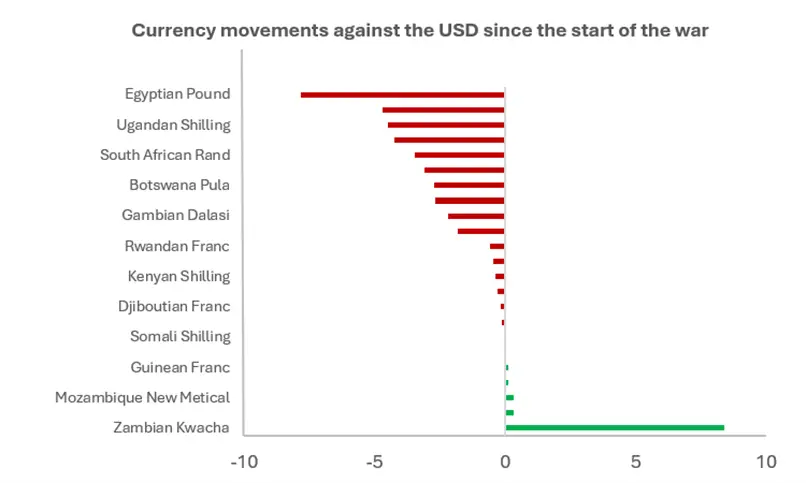
A stronger kwacha reflects improving external fundamentals
Source: Bloomberg
Note: Negative values denote depreciation against the USD while positive values indicate appreciation, in terms of %
Zambia’s external position is expected to strengthen further this year, with the current account projected to swing back into surplus on the back of stronger copper exports amid rising demand from data centres and the global energy transition. The resulting increase in foreign exchange inflows has contributed to a marked appreciation of the kwacha, which has strengthened by more than 30% year-on-year against the US dollar. Meanwhile, gross international reserves rose to USD 6.4 billion in April 2026, equivalent to around 4.4 months of prospective import cover, providing a stronger buffer against external shocks.
Looking ahead, some exchange rate volatility and a partial reversal of recent gains could emerge in the run-up to the August elections. Nevertheless, we expect any depreciation pressures to prove temporary, with improving external fundamentals, stronger reserve buffers and continued support from copper exports helping to underpin the currency over the medium term. As such, while the exceptional gains recorded over the past year are unlikely to be repeated, we expect the balance of risks to remain tilted towards currency stability rather than a reversal of recent gains.
MCB Research
If you have any questions or need assistance, our dedicated support team is here to help: Research desk on research@mcbgroup.com or MCB Global Markets Team on gmsales@mcb.mu
Disclaimer:
“This publication is provided for general information purposes only and should not be construed as investment advice, a recommendation, an offer or solicitation to buy or sell any financial instrument or to participate in any trading strategy. The views and opinions expressed are those of the author(s) as of the date indicated and are subject to change without notice. They do not necessarily represent the views of The Mauritius Commercial Bank Ltd (“MCB”) or any of its affiliates. Although the information contained herein is obtained from sources believed to be reliable, MCB makes no representation or warranty, express or implied, as to its accuracy, completeness, or fitness for any particular purpose. Past performance is not indicative of future results, and all investments involve risk, including the possible loss of principal. Neither MCB nor any of its directors, officers, or employees accepts any liability for any direct or consequential loss arising from any use of this publication or its contents. Recipients should seek independent financial, legal or tax advice before making any investment decisions.”
Recent Articles


TH!NK

.webp?sfvrsn=bdba599c_1)

Subscribe to our Email Alerts
Stay up-to-date with our latest releases delivered straight to your inbox.
Contact
Don't hesitate to contact us for additional info
Email alerts
Keep abreast of our financial updates.