

- Home
- Investors Centre
- Sustainability
- Talent
- News
- Insights
- TH!NK
- Board of Directors
- Community
- MCB Offices
Contact Info
El Niño 2026-2027: Fresh Headwinds for Inflation and Food Security in Africa
.webp?sfvrsn=5062fff6_1)
African economies are entering the anticipated El Niño cycle from an already fragile macroeconomic position. Elevated oil prices, rising fertiliser costs and tighter global financial conditions linked to the US–Israel–Iran conflict have strained external balances, weakened currencies and tightened policy space across the region. In this context, the expected 2026–2027 El Niño represents an additional layer of risk rather than a standalone shock. By disrupting rainfall patterns, raising temperatures and affecting ocean productivity, it is likely to further destabilise agricultural output, intensify food price pressures and widen trade deficits, compounding existing macroeconomic vulnerabilities.
Price evolution of key agricultural commodities (YTD, %)
d9547eefd5a64eae959bde23ccebe475.webp?sfvrsn=d2f23034_1 "download (2)")
Source: Bloomberg
Current forecasts point decisively toward a meaningful event. The probability of El Niño developing between May and June 2026 is estimated at around 82%, with a strong likelihood that it will persist into its December 2026 to February 2027 peak. More importantly, there is roughly a two‑thirds probability that the event will reach strong or very strong intensity, although a “super” El Niño remains a tail risk, rather than the base case.
El Niño strength probabilities (%)
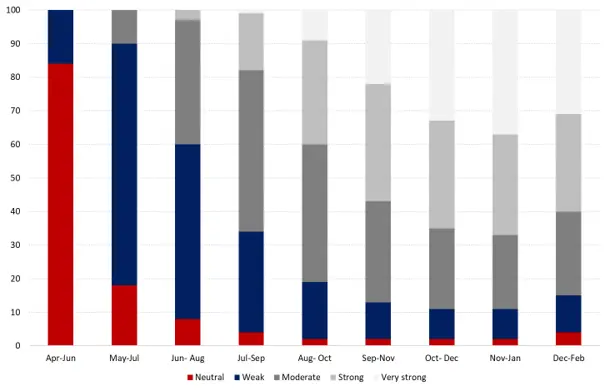
Source: Climate Prediction Center - Official NOAA CPC ENSO Strength Probabilities
From an economic perspective, this matters because the intensity of El Niño is closely correlated with the magnitude of its downstream effects on weather extremes, agricultural output and global commodity prices.
Estimated global food commodity price effects of a transition from a normal to a strong El Niño
36e6ac9eb9bd4b44b22d712a7b4a4561.webp?sfvrsn=fe5be7bb_1 "download (1)")
Sources: Haver, US NOAA and ECB staff calculation
The primary transmission channel is through weather disruption, which manifests unevenly across Africa. These weather shocks translate most directly into agriculture, the primary channel through which El Niño affects economic activity. In turn, disruptions to agricultural output feed into trade balances and policy responses, complicating efforts to manage inflation and external stability.
.webp?sfvrsn=737c6c37_1 "download (3)")
Source: International Research Institute for Climate and Society, note that the red shading indicates above-normal temperatures
Agricultural impacts across Africa
.webp?sfvrsn=7d871474_1 "download (4)")
Fisheries and marine system disruptions
Another channel is through fisheries and the broader marine economy, particularly in the Indian Ocean. El Niño reduces ocean productivity by weakening nutrient upwelling, which is essential for sustaining marine food chains. This leads to declines in fish stocks and shifts in species distribution. As a result, global fisheries output typically falls by 1% to 3.5% during El Niño episodes, with larger disruptions under stronger events. In the Indian Ocean, where around 70% of El Niño events have detectable impacts on marine conditions, catch volumes for key species such as tuna and sardines can decline, affecting both export earnings and domestic food supply. For coastal African economies, these effects reinforce pressures emerging from agriculture, creating a broader food system shock.
External position implications
Trade impacts will be uneven. South Africa, with agricultural exports of US$15.1 billion in 2025 (around 13% of total merchandise exports), should see trimmed maize surpluses but retain its position as a key regional supplier. Zimbabwe and Zambia face sharper vulnerabilities, with Zimbabwe likely shifting once more to net maize importer status. Smaller agriculture-dependent economies such as Malawi and Mozambique will encounter similar strains on their external accounts, while East African nations may require higher cereal imports amid disrupted rainfall and logistics.
The 2015–16 El Niño offers a useful, if imperfect, reference point for the FX implications. African currencies came under severe pressure during that episode — the rand fell from around R11.5/USD to nearly R16/USD over the course of 2015, while the Zambian kwacha lost around 40% of its value — but it would be misleading to attribute those moves primarily to El Niño. Dollar strength driven by the Fed’s first rate hike cycle since 2006, a sharp Chinese-led commodity demand slowdown, and South Africa-specific political shocks (most notably the abrupt removal of Finance Minister Nhlanhla Nene in December 2015) were each significant drivers in their own right. What El Niño contributed was an additional tightening of the agricultural trade balance and a sharp domestic food price shock: retail white maize prices surged 98% in South Africa and 41% in Zambia between March 2015 and March 2016, adding to inflationary pressures that were already building from currency weakness. The lesson for 2026–27 is therefore not that El Niño directly drives currency depreciation, but that it tends to arrive alongside or amplify other macro pressures.
The current backdrop — with most African currencies already strained by higher oil import bills linked to the US–Israel–Iran conflict — raises the risk of a similar co-occurrence, where El Niño’s trade balance and food price effects compound pre-existing vulnerabilities rather than act as the sole or primary driver.
Overall, stronger import demand for cereals and other staples is likely to elevate food import bills. The consequence is a deterioration in terms of trade, increased pressure on current account balances, and heightened currency vulnerability in import-dependent economies. This comes at a time when most African currencies are already under pressure from higher oil import bills linked to the war, with El Niño acting as an additional destabilising force.
Performance of key African currencies (YTD, %).webp?sfvrsn=4c26dc48_1 "download (5)")
Source: Bloomberg
Inflation dynamics and monetary policy response
The final transmission channel operates through inflation and monetary policy. Food has a high weight in consumer price baskets across Africa, meaning that supply shocks translate quickly into headline inflation. Reduced domestic production, combined with higher global prices and currency depreciation, creates a reinforcing cycle of price increases. In hydropower-dependent economies, an additional layer of risk emerges: lower rainfall can reduce electricity generation, raising energy costs and feeding into broader production expenses. For central banks, the policy implications are challenging. The combination of weaker growth dynamics, driven by lower agricultural output, and rising inflation creates a stagflation-like environment. This could translate into tighter monetary conditions for longer, or even renewed rate hikes in some jurisdictions, despite fragile growth.
Ultimately, the 2026–2027 El Niño underscores the extent to which climate variability has become a systemic macroeconomic risk for Africa. Its impact propagates through a clear chain: weather disruption affects agricultural and fisheries output, which in turn drives trade imbalances, inflation, and policy responses. At a time of already constrained fiscal and monetary space, the event is likely to test the resilience of African economies.
For more information, please contact MCB Global Markets Team on gmsales@mcb.mu
Published in collaboration with our Strategy, Research and Development team and our Financial Markets research partner, ETM Group.
Disclaimer
“This publication is provided for general information purposes only and should not be construed as investment advice, a recommendation, an offer or solicitation to buy or sell any financial instrument or to participate in any trading strategy. The views and opinions expressed are those of the author(s) as of the date indicated and are subject to change without notice.
They do not necessarily represent the views of The Mauritius Commercial Bank Ltd (“MCB”) or any of its affiliates. Although the information contained herein is obtained from sources believed to be reliable, MCB makes no representation or warranty, express or implied, as to its accuracy, completeness, or fitness for any particular purpose. Past performance is not indicative of future results, and all investments involve risk, including the possible loss of principal.
Neither MCB nor any of its directors, officers, or employees accepts any liability for any direct or consequential loss arising from any use of this publication or its contents. Recipients should seek independent financial, legal or tax advice before making any investment decisions.”
Recent Articles





TH!NK





Subscribe to our Email Alerts
Stay up-to-date with our latest releases delivered straight to your inbox.
Contact
Don't hesitate to contact us for additional info
Email alerts
Keep abreast of our financial updates.