

- Home
- Investors Centre
- Sustainability
- Talent
- News
- Insights
- TH!NK
- Corporate Governance
- Who we are
- Board of Directors
- Community
- MCB Offices
Contact Info
Fertiliser and Metals Markets Feel the Hormuz Squeeze

The US-Israeli strikes on Iran and the disruption to the Strait of Hormuz have turned a regional conflict into a broad commodity shock. As a key artery for oil, fertilisers and sulphur, the strait’s instability is reverberating far beyond energy markets. While oil prices have surged, fertilisers and industrial metals also pose a risk as supply-chain stress is feeding into inflation risks and tighter physical markets.
Fertiliser markets are already under strain. Gulf producers supply a significant share of global nitrogen products such as urea and ammonia, much of which typically moves through Hormuz. Prices have risen on fears of shortages and higher transport costs, although not to the extreme levels seen during the 2022 Russia-Ukraine shock, leaving import-dependent regions like Africa particularly exposed. With planting seasons underway in parts of East and Southern Africa, any disruption risks reduced fertiliser use or delayed sowing, setting the stage for weaker and/or smaller crop yields and higher food prices later in the year. For many economies, that implies wider external deficits, currency pressure and a more complex inflation outlook.
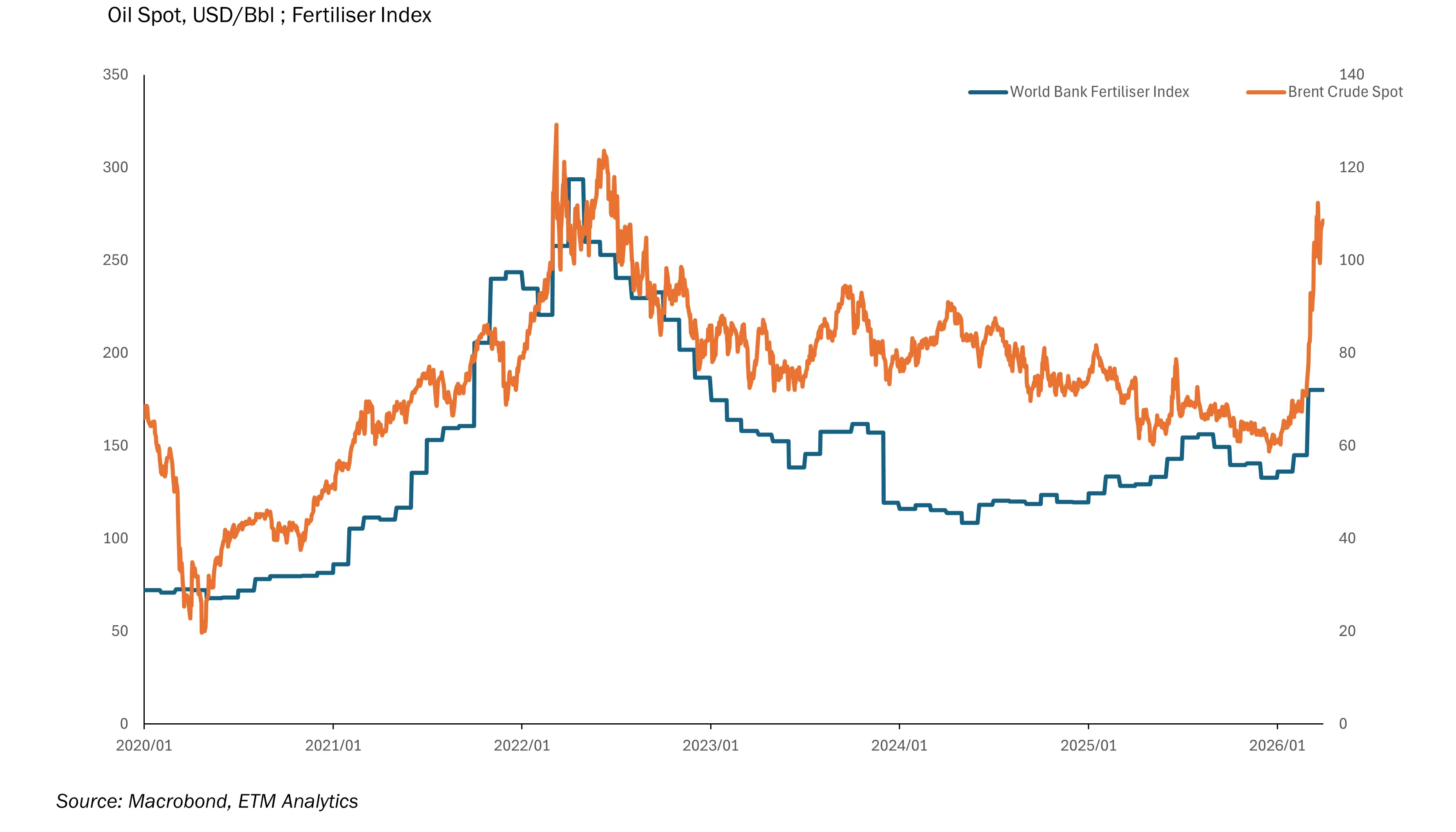
The disruption is also filtering into copper and cobalt markets through sulphur. Shipments of sulphur, a critical input for sulphuric acid used in oxide-ore processing, are facing delays. This is especially significant for the Central African Copperbelt, where producers of both copper and cobalt rely heavily on imported acid. Rising input costs and constrained supply threaten output, even as global prices remain tempered by softer growth expectations. The result is a market that may be underestimating the risk of tighter supply conditions later in the year.
Aluminium and bauxite markets are facing a chain of disruptions with direct implications for Africa. Gulf smelters, which produce a significant share of global aluminium outside China, are struggling with export bottlenecks and delays in securing alumina, the refined product of bauxite. This constrains smelter output, pushing prices higher and lifting physical premiums in Europe and Asia. African bauxite exporters, particularly Guinea, are affected as demand and shipping patterns shift, while countries like Mozambique and South Africa, involved in aluminium processing, face knock-on impacts on industrial activity and export revenues. Combined with aluminium’s energy-intensive production and rising fuel costs, these disruptions amplify the squeeze along the entire supply chain, linking Gulf production issues to economic pressures in Africa.
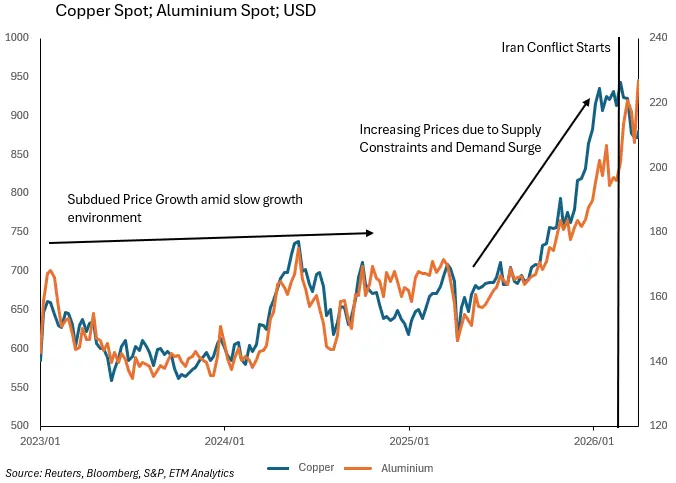
Of note, aluminium hit a four year high on April 1 after Emirates Global Aluminium, the Middle East’s top producer, halted output at one of its smelters due to Iranian missile and drone strikes. However, across these markets, a common theme is emerging. Futures curves suggest that traders expect the disruption to be temporary, with current price strength giving way to eventual normalisation. Yet that assumption hinges on a swift resolution. A more prolonged war would deepen inflation pressures, tighten supply further and complicate policy decisions, especially in import-dependent emerging markets already grappling with currency weakness.
What this episode ultimately underscores are not just the fragility of key trade routes, but the structural vulnerabilities beneath them. From Africa’s reliance on imported fertilisers to the Copperbelt’s dependence on sulphur, these fault lines are unlikely to fade quickly, even if the immediate shock does.
For more information, please contact MCB Global Markets Team on gmsales@mcb.mu
Published in collaboration with our Strategy, Research and Development team and our Financial Markets research partner, ETM Group.
Disclaimer
“This publication is provided for general information purposes only and should not be construed as investment advice, a recommendation, an offer or solicitation to buy or sell any financial instrument or to participate in any trading strategy. The views and opinions expressed are those of the author(s) as of the date indicated and are subject to change without notice.
They do not necessarily represent the views of The Mauritius Commercial Bank Ltd (“MCB”) or any of its affiliates. Although the information contained herein is obtained from sources believed to be reliable, MCB makes no representation or warranty, express or implied, as to its accuracy, completeness, or fitness for any particular purpose. Past performance is not indicative of future results, and all investments involve risk, including the possible loss of principal.
Neither MCB nor any of its directors, officers, or employees accepts any liability for any direct or consequential loss arising from any use of this publication or its contents. Recipients should seek independent financial, legal or tax advice before making any investment decisions.”
Recent Articles





TH!NK


.webp?sfvrsn=bdba599c_1)

Subscribe to our Email Alerts
Stay up-to-date with our latest releases delivered straight to your inbox.
Contact
Don't hesitate to contact us for additional info
Email alerts
Keep abreast of our financial updates.